
By Imran Salahuddin | Published on March 26th, 2026 |
Three years ago, when a client asked us how long it would take to migrate a 400,000-line VB6 app to .NET would take, we said 18 months. Now, with AI-supported tooling, the same project would take six. This is not a guess: it’s what I’ve observed in our migration practice over the last couple of years.
AI has gone from a buzzword on vendor slides to the most consequential change in how we actually execute legacy migrations. And in 2026, the tooling landscape has matured to a point where ignoring it means you’re choosing to migrate slower, more expensively, and with more risk than you need to.
In the span of a single month this March, three things happened that would have been unimaginable two years ago. Microsoft launched its modernize-dotnet agent for GitHub Copilot – an AI that can provide a report on your legacy ..NET system, create an upgrade strategy, and generate code changes across the codebase. CLPS Incorporation finished a proof-of-concept for a large Hong Kong bank, migrating its core COBOL systems to Java, while retaining business logic, with an AI-powered tool. And Hexaview released Legacy Insights, an AI documentation tool that achieved 94% accuracy on the LegacyCodeBench dataset – 20 points better than GPT-4o on intricate enterprise COBOL programs. These are not research projects. They are real tools being used in banking, insurance and health care – which are the bulk of our clients at MigrateTo.NET.
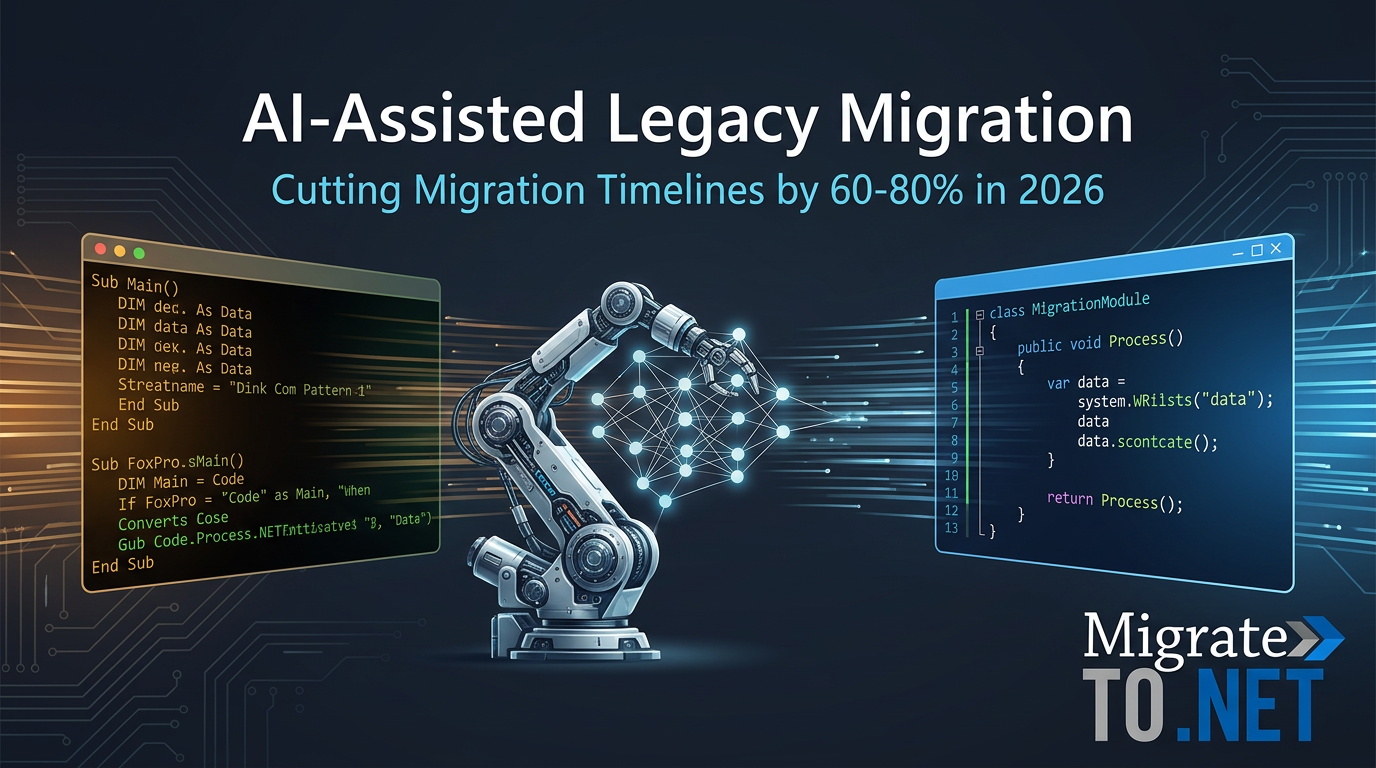
I must be explicit here since it is so easy to lose sight of what is really helpful in software development because of the noise about AI. In a legacy migration, AI does not take over the migration engineer. It removes the manual labor that eats up 60-70 percent of the project schedule. The most obvious example is that of code analysis. An application of VFP with 200,000 lines of code would take weeks before the manual code could be reviewed and dependencies mapped, dead code found, and business rules cataloged. Much of that analysis was already done by our FoxPro Code Matrix tool and SpecGenerator. However, with AI overlayed on top of it – our generative AI extension CodeAuto – the system is now able to read old code, generate inline documentation, describe complex functions in plain English and warn about patterns that will fail during conversion. What would have required days to be done can now be done in hours. The second area is code conversion. CodeAuto supports language-to-language translation – VB6 to C#, VFP to .NET, ASP to ASP.NET – with language contextual suggestions that extends beyond key-word replacement. It rewrites code, writes unit test scripts, and identifies errors that could have been missed by a manual inspection. With our CodeMorph automation engine, which supports production quality bulk conversion, the end product is a pipeline which converts legacy code to modern .NET in a fraction of the time. This month, ZDNET published a report stating that unmanaged technical debt is eating up to 40 percent of IT development time. AI migration tools strike directly at that figure by condensing the most labor-intensive stages of the project.
The 2026 Enterprise Java Migration Guide published by LegacyLeap has provided information that migration times can be shortened by 60% through the use of generative AI and automation and that code verification can be made more accurate. The internal performance measurements of our own MigrateTo.NET, in dozens of VB6 and VFP projects, indicate that the 60 to 80 percent increase in efficiency using CodeAuto and CodeMorph in tandem.
Those benefits are in four categories: automated code analysis, AI-assisted code conversion, auto-generated unit tests, and intelligent documentation. Every step that once needed a developer hour spent on it is being augmented, not replaced, but reduced by a factor of four or five. All architectural decisions are still made by the migration engineer. The monotonous labor is taken care of by the AI.
The timing is critical. As we stated in the post before, legacy applications are impeding enterprise AI strategies. It requires companies to migrate – yet many have been procrastinating because the process has seemed to be long, expensive and dangerous. The AI tooling eradicates such objections. The recent release of Azure Copilot Migration and GitHub Copilot Modernization agents this month is an indication that the biggest technology company on earth has decided that AI-assisted migration is now a product category. AWS is developing the same capabilities using Amazon Q Developer and their mainframe modernization stack. When both Microsoft and AWS are spending this much, it is evident where it is headed. At MigrateTo.NET we have incorporated CodeAuto in all stages of our migration process, starting with initial assessment, through code conversion, testing and finally deployment. Together with our Dazzle 3.0 .NET Foundation Framework and our 5-step Scrum migration process, the outcome is a migration practice that provides shorter timelines without compromising the rigor required by enterprise clients.
Migration to legacy is no longer what it was in 2023. It is not a simple process – the complex business rules, data integrity, and regulations compliance still needs human skills. But it has now made the prosaic to fly. When your legacy migration vendor does not use AI-enhanced tools, they are letting you pay them to have a machine do the work. Whether AI will transform legacy migration or not is not a question. It has. The question is whether your company will use it to finally catch up.