
By Imran Salahuddin | Published on April 10th, 2026 |
The decision on whether to use manual and automated code conversion is a high-stakes one that characterizes the technical debt of your organization in the coming decade. The necessity to move towards modern frameworks due to increasing costs of maintaining legacy systems has introduced a gap between two extremely distinct philosophies of engineering. One is the artisanal accuracy of the manual rewrite and the other is the industrial speed of automation.
By 2026, there is no distinction between these approaches with advanced AI-driven agents, but the underlying trade-offs still exist. In order to take the correct course of action, you must not only look past the short-term deadline but also consider the long-term health of your codebase.
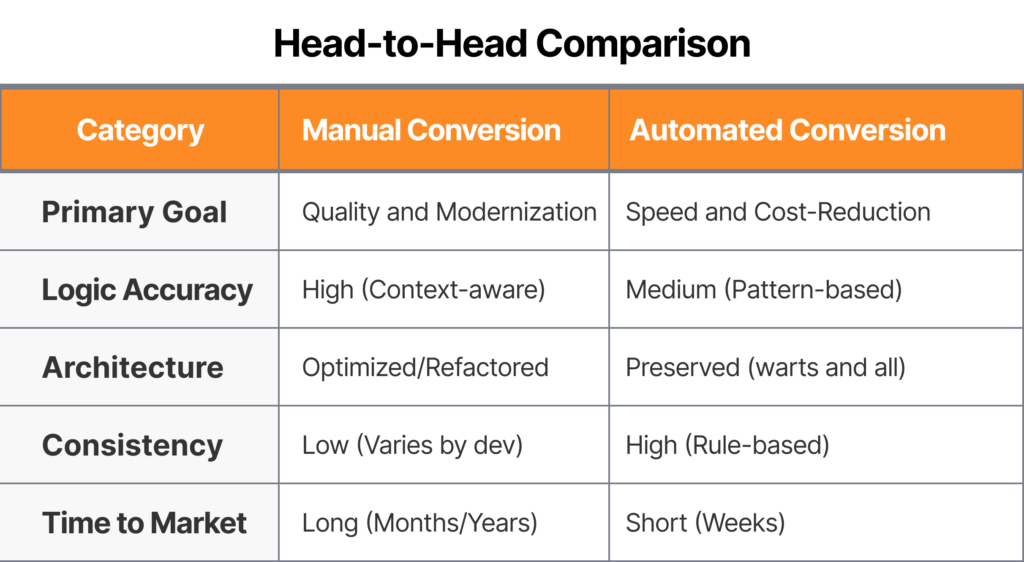
Manual conversion: Manual conversion involves human programmers converting logic written in one language to a language written in a different language. It is not often a direct translation, rather it is a re-conception of the software.
A human programmer does not simply view syntax but views purpose. Older code is often full of hacks around features that are no longer present. Writing a manual again enables a developer to recognize a 2012 hack that was written in a convoluted way and to use it to replace it with a native single-purpose function in a modern library.
The only method of successfully shifting paradigms is also through this approach. A machine will not cope with the structural why, even in the case of a procedural language such as COBOL to an object-oriented language such as Java, or even in the case of a functional language such as Haskell. A human has the opportunity to restructure the application and exploit the full capabilities of the new language to its fullest, like concurrency models or memory management.
The main disadvantage of the manual conversion is the “Human Bottleneck. It is extremely sluggish and depends on the different ability levels of the team. If three different developers are rewriting three different modules, you may end up with three different architectural styles unless you have a rigorous (and time-consuming) peer-review process. Moreover, manual conversion is the most costly with regard to initial capital. You are buying top-level brainpower to do what is frequently tedious.
Automated code conversion is an automated approach to converting source code into the target language that uses tools, including simple rule-based transpilers, or advanced AI-based models, to interpret the input code and produce the output.
In the case of millions of lines of code in thousands of files, hand conversion is logistically impossible. Automation is good in the following bulk situations. A properly-programmed conversion engine is able to read a complete repository in a fraction of the time it would take a human to read it. This can be especially handy when undertaking migrations to step off of a failing hardware platform or a licensing nightmare in short order.
Automation lacks nuance, which is its Achilles’ heel. The majority of the tools do a transliteration but not translation. They draw the map Syntax A to Syntax B without knowing whether Syntax A was an error in the first place. This leads to what is called a Jobol (Java, which appears to be COBOL) or a Pyth-C (Python, which appears to be C).
The result is frequently practical but un-idiomatic. It does not appear like what a native developer would write and therefore, it becomes difficult to maintain, debug and extend. You successfully swap a legacy language issue with a technical debt issue.
This is no longer a binary choice in the most successful modernization projects of today. Instead, they adopt a tiered approach which exploits the benefits of the two worlds.
It starts with an automated tool that does the “boring” bits of the conversion: data structures, simple syntax and standard boilerplate. This will take the project 60-80 percent of the way across the finish line in a flash.
Rather than having developers rewrite everything, they are deployed specifically to “high-value” areas. These include:
Testing is the secret third pillar of code conversion. In a hybrid model, automated “equivalence testing” tools compare the output of the old system against the new system. If the outputs differ by even a single bit, the code is flagged for a manual audit.
Automation will flourish in case your legacy code is well documented and adheres to clear patterns. In the event that it is a black box and nobody knows how the core logic works, it has to be explored manually, to avoid the transfer of vital bugs.
There is an old engineering adage: “Garbage in, garbage out.” Automated tools cannot distinguish between “mission-critical logic” and “dead code” that hasn’t been used in a decade. Before any conversion starts, a manual “pruning” phase is required to ensure you aren’t paying to migrate useless junk.
Are there developers who are knowledgeable in both the new language and the old one? And when the answer is no, then you must go to automation. A manual rewrite can be an effective method of allowing a team of experts familiar with the old system to get it right the first time.
Manual conversion is best for core intellectual property. When the code is the special logic that enables your business to be profitable, do not put it into the hands of a machine. The human touch makes the architecture designed to last no less than twenty years, not twenty minutes.
Infrastructure and utility are best automated. The basic data CRUD operations and internal reporting, thousands of lines of code that deal with file I/O, leave the machines to do the heavy lifting. It is quicker, less expensive and consistent.
The “Best” option is nearly always 60/40. Automation can be used to take the back of the workload, and then rely on your most expensive human resources to offer the intuition, security, and elegance that a tool alone can never acquire. Code conversion is not only about taking logic and transferring it, it is about having a second life of your software. The quality of such life is not to be killed by the passion to be speedy.