By Joe Rafanelli | Published on February 26th, 2026 |
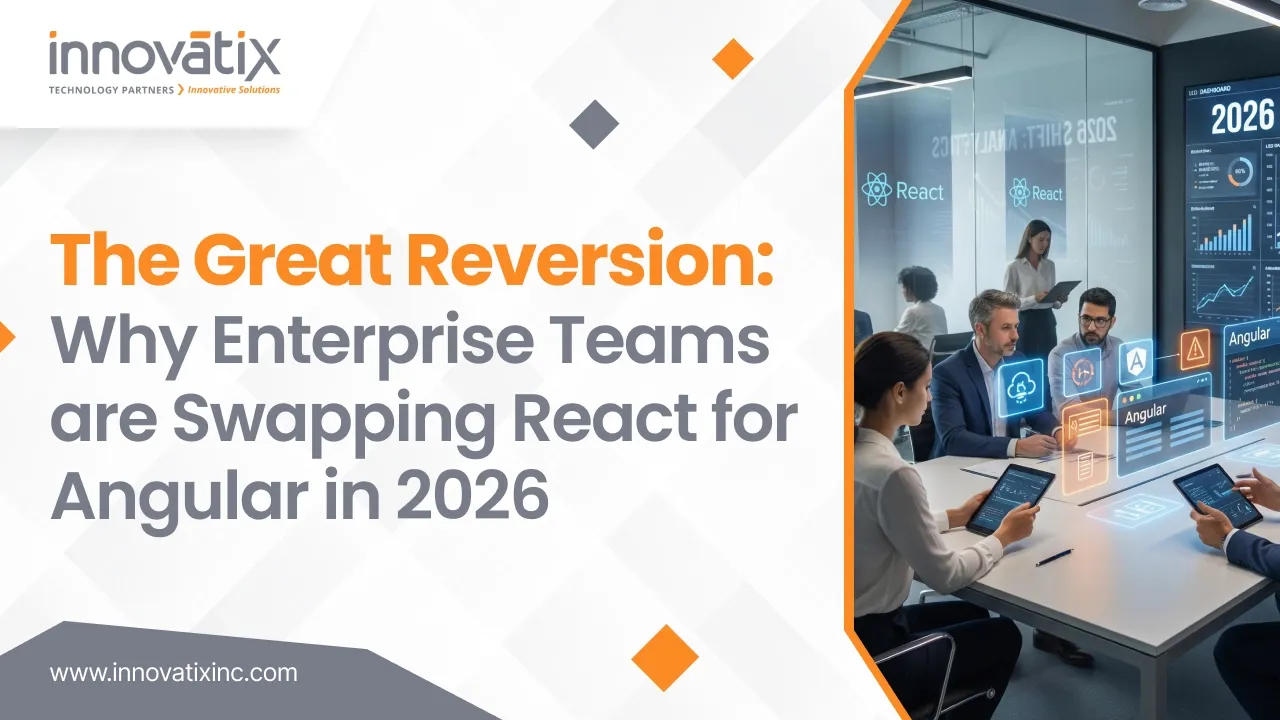
For years, the frontend landscape has been dominated by the lively dance between React and Angular. While React, with its flexible library approach and vibrant community, often seemed to capture the hearts of many developers, a quiet but significant shift has been occurring behind the scenes, particularly within the enterprise sector. With this trend, as we enter 2026 we are witnessing a resurgence of strategic mission-critical enterprise applications moving to Angular once again.
This isn’t simply a decision made based on whimsy, nor is it a rejection of the benefits of using React. Rather, it’s a calculated move made by large organizations, driven by the changing needs and priorities of the organization.
Let’s take a closer look at the primary reasons why enterprise teams are beginning to go back to the fold of Angular.
1. Stability and Predictability: The Enterprise Imperative
Stability is what drives successful enterprise software. Because enterprise software is often developed to last for years, with large amounts of maintenance required after the initial launch, enterprise developers require a framework that provides predictable evolution and minimizes breaking changes. In this regard, Angular excels in providing a stable platform.
- Opinionated Structure: While some developers may view Angular’s opinionated nature as overly restrictive, it is actually one of the largest advantages that Angular provides for large teams of developers. It enforces best practices, provides a clear outline of how your project should be structured, and eliminates the “paradox of choice” that exists in the open-source, self-directed development of React projects. With Angular, new team members are able to quickly ramp-up and become productive, and your codebase will remain maintainable throughout the life cycle of your project.
- Managed Evolution: Google has committed to developing Angular and has provided a predictable release schedule and clear deprecation policy for the framework. Such predictability enables businesses to make upgrades and migrations confidently, with minimal disruptions affecting business operations that are key to business. While React’s more fragmented ecosystem can provide developers with a wide variety of innovative and creative approaches to solving problems, the frequency of these new approaches can result in more unpredictable shifts in best practices and tooling.
Developing enterprise applications involves more than simply providing a UI library; you must also develop a comprehensive tooling ecosystem that includes libraries, best practices and more. Angular is a complete environment, and it provides an all-in-one suite.
- CLI Excellence: The Angular CLI is a developer’s dream. From generating components and services to handling testing, bundling, and deployment, the CLI streamlines development workflows and enforces consistency across projects. This combined method eliminates the necessity of teams to study, analyze, and unite separate tools, which is a huge waste of time and effort.
- Integrated Solutions: Angular provides built-in solutions for routing, state management (with NgRx or services), forms, and HTTP client interactions. React users assemble a set of similar features with other third-party libraries, Angular provides a consistent, officially maintained solution that makes them less concerned with compatibility and integration pain.
- Enterprise-Grade Libraries: The Angular ecosystem has matured greatly and now offers a wide variety of enterprise-grade UI component libraries (such as Angular Material) and other tools that are specifically designed to meet the scalability and accessibility needs of large-scale enterprise applications.
Although the two frameworks can be used to create high-performance applications, the architecture of Angular offers certain benefits in large-scale enterprise solutions.
- Ahead-of-Time (AOT) Compilation: Angular’s AOT compiler transforms HTML and TypeScript code into efficient JavaScript during the build phase. his results in faster page renderings, smaller bundle sizes, and better runtime performance, which is a must-have for applications that will be used by thousands of users worldwide.
- Ivy Renderer: The Ivy renderer has greatly improved Angular’s bundle sizes, build times, and runtime performance. These continuous improvements demonstrate Google’s ongoing efforts to keep Angular competitive in terms of performance.
- Tree-shaking and Lazy Loading: Through Angular’s modular design and the Angular CLI’s ability to enable lazy loading modules and tree-shaking unused code, developers are able to ship only the code that is necessary to the end-user’s browser, enabling faster initial loads — a key factor in user experience for enterprise applications.
4. Maintainability and Scalability: Managing Complexity
Enterprise applications are complex in their nature. They include several teams, complexity of business logic, and a life cycle which does not always take less than ten years. Maintainability and scalability are paramount.
- TypeScript by Default: Angular’s strong typing with TypeScript is a game-changer for large codebases. It detects errors during compile time and not at runtime resulting in stronger and less prone to errors applications. This reduces debugging time and improves code quality across distributed teams.
- Modular Architecture: Angular’s component-based and module-based architecture naturally encourages a highly modular and organized codebase. This makes it easier to manage complexity, split work among teams, and scale applications without them devolving into an unmanageable monolith.
- Dependency Injection: Angular’s powerful dependency injection system promotes loose coupling and testability, making it easier to manage complex relationships between components and services, and facilitating unit testing.
5. Talent Pool and Training: The Long-Term View
While React appeals to a broad range of developers, the enterprise is typically looking for developers who possess a specific skill set that supports the long-term stability of the project.
- Structured Learning Path: Angular provides a more defined and structured learning path, which can be useful when bringing new junior developers on board and maintaining a consistent skill set across the entire team. Furthermore, the opinionated nature of Angular means that developers spend less time trying to figure things out, and more time learning established patterns.
- Enterprise Focus: Many developers attracted to Angular enjoy the fact that it is an enterprise-focused framework, and they get to work on large, complex systems. This provides a talent pool that is generally well-suited to the demands of enterprise development.
- Reduced Context Switching: With a comprehensive framework, developers spend less time context-switching between different libraries and more time focusing on business logic, leading to increased productivity.
The Verdict: A Strategic Bet
Getting back to Angular in 2026 is not a pointer of the decline of React, but more of a statement of the shifting of priorities within enterprise teams. Although React is an outstanding match to numerous projects, especially those with the high level of flexibility and speedy development of smaller teams, the stability, extensive tooling, predictable development, and solid maintainability offered by Angular are becoming invaluable as far as the sustainable success of a critical enterprise application is concerned.
For organizations that prioritize consistency, scalability, and a managed ecosystem for their mission-critical software, Angular is not just a framework; it’s a strategic bet on the future. The great reversion is already underway, and Angular is once again proving itself to be the enterprise workhorse of the modern web.
Joe Rafanelli is the Director of Migration Services at Innovatix Technology Partners, a Macrosoft, Inc. company. In this capacity, Joe acts as the single point of contact for Innovatix’s migration solutions. Additionally, he collaborates with internal technology analysts to understand requirements, work scope, and maintain client relationships ensuring their satisfaction .
Prior to joining Innovatix in May 2017, Joe had a resplendent career in the Banking Industry spanning 25 years. He focused on Account Management, Project Management, Implementation Management, and Product Development for companies like JPMorgan, Citigroup and Brown Brother Harriman.
Joe is excellent at improving the client experience by driving change management projects to completion. Joe has B.S. Finance, MBA Investment Finance, Project Management certificate & Database Management certificate.