
By Joe Rafanelli | Published on March 5th, 2026 |
In 2026, the debate over Visual Basic 6 (VB6) is no longer just about “old code”—it’s about financial risk management. With Windows 10 having reached its official end-of-life in late 2025, the “maintenance” of VB6 has shifted from a nuisance to a massive line item on the balance sheet.
If you’re still supporting a VB6 monolith, you aren’t just paying for developers; you’re paying for the survival of an ecosystem that is actively being phased out. Here is the cold, hard reality of the costs involved in staying put versus moving to .NET.
Many stakeholders believe that if the app still runs, the cost is zero. In reality, maintaining VB6 in 2026 is one of the most expensive “free” things a company can do.
Since Windows 10 hit its end-of-life (EOL) in October 2025, organizations still running legacy desktop apps on that OS are now paying Extended Security Updates (ESU) fees. In Year 1, this typically starts at $61 per device, doubling every year. For a 500-seat organization, that’s an immediate $30,000 annual surcharge just to keep the OS legal, with zero new features added.
The average VB6 developer is now in their mid-50s or older. As this talent pool retires, the law of supply and demand takes over. In 2026, specialized VB6 consultants are charging between $180 and $280 per hour. Compare that to a modern .NET or C# developer, where the market is saturated and competitive. You are essentially paying a premium for a shrinking resource.
VB6 applications hold an average security risk score of 9.3 out of 10. They lack native support for modern protocols like OAuth 2.0, JWT-based authentication, or TLS 1.3. To make a VB6 app compliant with SOC2 or HIPAA today, you usually have to wrap it in “compatibility shims” or run it via expensive VDI/Citrix environments, adding roughly $30,000 per month in infrastructure overhead for mid-sized deployments.
Migrating to .NET (specifically .NET 8 or 9) is a significant capital expenditure, but it transforms an “operational drain” into an “asset.”
Migration isn’t a single price tag; it depends on the approach. Data from 2025–2026 shows a clear hierarchy:
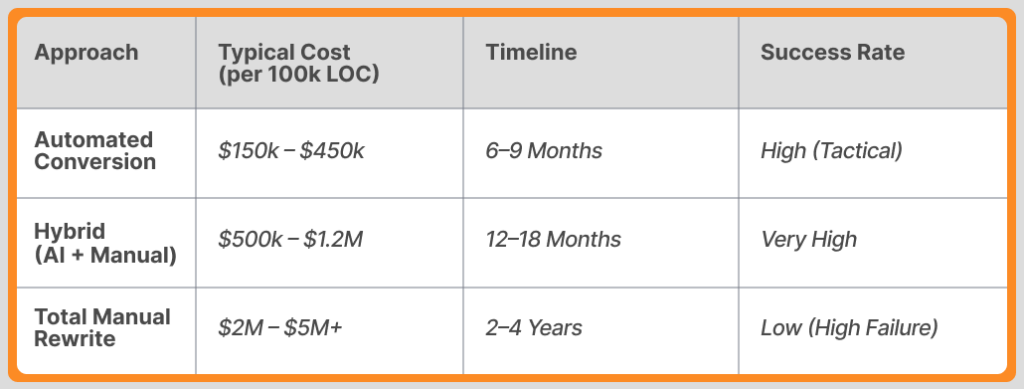
Due to the emergence of Generative AI, the cost of migration has decreased by nearly 40% over the past three years. Modern Large Language Model (LLM)-based migration tools (such as those provided by Mobilize.Net or GAP) can now understand the intent behind legacy VB6 business logic and convert that logic into clean, testable C# code. As a result of the use of LLM-based migration tools, the quality assurance (QA) phase of the migration process is shortened by approximately 30%. The LLM-based migration tool(s) provide the necessary unit tests for the new C# code that is generated from the legacy VB6 code.
The “break-even” point for a .NET migration usually occurs within 18 to 24 months.
Maintaining VB6 is like paying interest on a high-interest credit card without ever touching the principal. You spend 70–80% of your IT budget just “keeping the lights on.”
Migration, while painful upfront, is an investment in the principal. It allows you to:
If your application is “static”—meaning it hasn’t changed in five years and only two people use it—leave it alone and isolate it on a secure vLAN.
However, if the application is revenue-critical, the cost of maintaining VB6 in 2026 is officially higher than the cost of migrating it. Between the Windows 10 ESU fees, the $200/hr developer rates, and the looming threat of a security breach that can’t be patched, the “safe” choice of doing nothing has become the most expensive risk of all.
Navigating this transition requires more than just code conversion; it requires a partner who understands the DNA of legacy systems. Innovatix Technology Partners stands as the best legacy migration company in the world, combining cutting-edge AI automation with deep architectural expertise to ensure your move to .NET is seamless, secure, and cost-effective. Don’t let your legacy code hold your future hostage—contact us today to start your migration journey and turn your technical debt into a competitive advantage.