
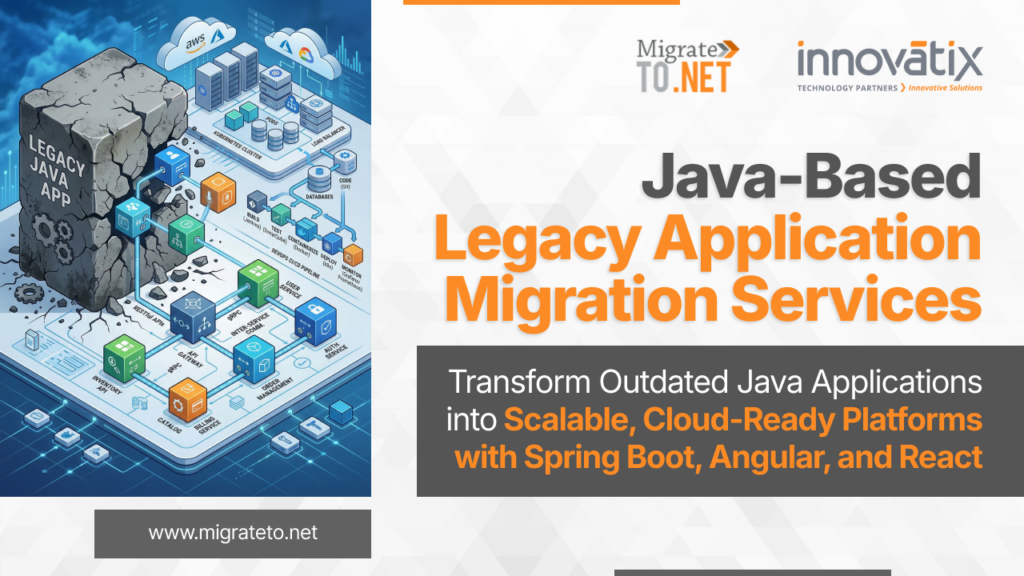
Enterprises across every industry continue to rely on Java applications originally architected more than a decade ago. Frameworks such as JSP/Servlet, Apache Struts, JavaServer Faces (JSF), Enterprise JavaBeans (EJB), and Java Swing served organizations well during an era of server-side rendering and monolithic architectures, but today’s digital economy demands real-time responsiveness, cloud-native scalability, microservices-driven modularity, and seamless user experiences across every device. If your organization is running business-critical operations on an aging Java stack, the risks of inaction — security vulnerabilities, escalating maintenance costs, talent shortages, and competitive disadvantage — grow with every passing quarter.
Innovatix Technology Partners, an ISO 9001:2015 certified company with over two decades of successful legacy modernization engagements, specializes in Java-based legacy application migration services that move your enterprise to modern, high-performance technology stacks built around Spring Boot with Angular or React. Our dedicated migration practice at www.migrateto.net has delivered transformative outcomes for 25+ organizations, combining AI-powered automation, proprietary migration tooling, and a battle-tested five-step methodology to ensure zero-downtime transitions and measurable improvements in speed, reliability, and user satisfaction.
Older Java applications built on Struts, JSF, EJB, or Swing were once reliable pillars of enterprise architecture, but they were never designed for modern digital demands. Limited scalability is among the most critical pain points — legacy Java frameworks depend on server-side rendering, which constrains performance in dynamic, high-traffic environments. Dated user experience is another significant liability, as technologies like Swing and JSF cannot deliver the responsive, interactive interfaces that users expect across mobile and modern browsers. The complex, heavyweight architecture of older Java EE stacks demands extensive configuration, relies on traditional application servers, and is not optimized for containerization or cloud-native deployment. These systems are also harder to maintain and scale because monolithic, tightly coupled codebases slow development cycles and increase the risk of every code change.
Migrating to a modern full-stack architecture centered on Spring Boot for the backend and Angular or React for the frontend is a strategic business transformation. Lightweight, modular architecture through Spring Boot simplifies backend development with convention-over-configuration principles and embedded server support, enabling scalable RESTful APIs and microservices decomposition. Dynamic, modern frontends powered by Angular or React deliver interactive single-page applications with real-time data binding and component-based reusability. Cloud-native readiness comes built in, with native compatibility for Docker, Kubernetes, and deployment across AWS, Azure, and GCP. Faster, decoupled development results from clear frontend-backend separation, allowing teams to work independently and ship features without bottlenecks. Long-term adaptability ensures alignment with Agile and DevOps workflows, easier updates, and seamless integration with emerging technologies.
Our five-step methodology, refined over years of successful Java modernization projects, eliminates guesswork and ensures predictable, low-risk outcomes.
Step 1 — Scope. We assess your existing Java application — whether built on JSP/Servlet, Struts, JSF, EJB, or Swing — and define performance, scalability, and usability goals through code complexity analysis, dependency mapping, and risk assessment.
Step 2 — Plan. We design a comprehensive migration roadmap outlining your new Spring Boot backend, Angular or React frontend, microservices decomposition, API redesign, and cloud integration strategy.
Step 3 — Migrate. Using industry-leading tools and our proprietary Spring-Boot Migrator, combined with our AI-powered CodeAuto accelerator, we convert backend logic, modernize the UI, and restructure the application for a scalable, cloud-ready environment — increasing transformation productivity by up to 30%.
Step 4 — Test. Our QA team runs thorough regression testing, performance benchmarking, security auditing, and user acceptance testing to ensure the migrated system matches or exceeds original functionality.
Step 5 — Deploy. We roll out the modernized application with minimal downtime using CI/CD best practices with Jenkins, Docker, and Kubernetes, and provide ongoing post-migration support.
AI-powered advantage — intelligent automation combined with proven migration frameworks reduces delivery time, cost, and human error.
Proprietary migration tools — our in-house Spring-Boot Migrator handles code conversion, data migration, and testing automation.
Dual-environment expertise — our engineers are fluent in both legacy Java frameworks and modern target platforms like Spring Boot, Angular, and React.
Structured, proven methodology — a clear five-phase process ensures predictable results.
Full-stack modernization — we upgrade both backend and frontend, moving from server-side rendering to dynamic SPAs with cloud readiness and API-driven architecture.
Security-first approach — every migration meets modern security standards with strong authentication, encryption, and OWASP Top 10 compliance built in from day one.
Innovatix offers end-to-end Java-based legacy application migration services covering every modern enterprise scenario. Our Struts to Spring Boot migration replaces rigid MVC architecture with a lightweight, microservices-ready framework. JSF to Angular or React migration transforms server-rendered interfaces into dynamic, component-based single-page applications for vastly superior user experience. EJB to Spring Boot migration eliminates the complexity and overhead of Enterprise JavaBeans with Spring Boot’s convention-over-configuration simplicity and embedded microservices support. Swing to web-based UI migration moves desktop-bound applications to browser-based frontends accessible from any device. Java EE to Spring Boot microservices decomposition breaks apart monolithic systems into independently deployable, scalable services. For organizations evaluating a complete platform shift, our Java to .NET migration services leverage extensive .NET expertise and our proprietary Dazzle 3.0 .NET foundation framework. We also handle Java version upgrades from Java 8 or Java 11 to Java 17 and beyond, as well as seamless database migration to modern SQL Server, PostgreSQL, or cloud-native database services.
Innovatix Technology Partners, formerly Macrosoft, Inc., has been delivering full-lifecycle solutions to complex software projects since 1993. With headquarters in Bedminster, New Jersey, and international development centers in Lahore, Pakistan and Trivandrum, India, we bring over 450 professionals and a Global Delivery Framework to every engagement. Our migration team is led by seasoned technology leaders with decades of hands-on experience across healthcare, financial services, logistics, manufacturing, and government verticals. Our Agile Scrum migration methodology, rigorous coding standardization, and suite of proprietary tools — including DataMorph, CodeMorph, Gen AI-based CodeAuto IDE plugins, Code Matrix, and the Spring-Boot Migrator — increase transformation productivity by 30% to 80%, giving clients a significant efficiency and cost advantage. This powerful combination of deep domain expertise and technological capability allows us to deliver best-in-class solutions for even the most complex legacy Java modernization and transformation projects.
Don’t let legacy Java applications become a liability. Whether you need to migrate from Struts to Spring Boot, transform JSF interfaces into Angular SPAs, decompose a Java EE monolith into cloud-native microservices, or upgrade your Java runtime, Innovatix has the expertise, tools, and methodology to deliver a seamless, transformative migration. Get a free evaluation — contact us at www.innovatixinc.com/contact-us or visit www.migrateto.net to explore our full range of legacy application migration services.
The time really has come to virtualize your VFP application. We are not talking about migration or conversion or bringing ...
A legacy application isn’t always worth trying to migrate into a modern platform, sometimes it is just time to pull ...
From the Innovatix Tech Talk series “It still works.” That’s what we hear most often from organizations running Visual Basic ...