
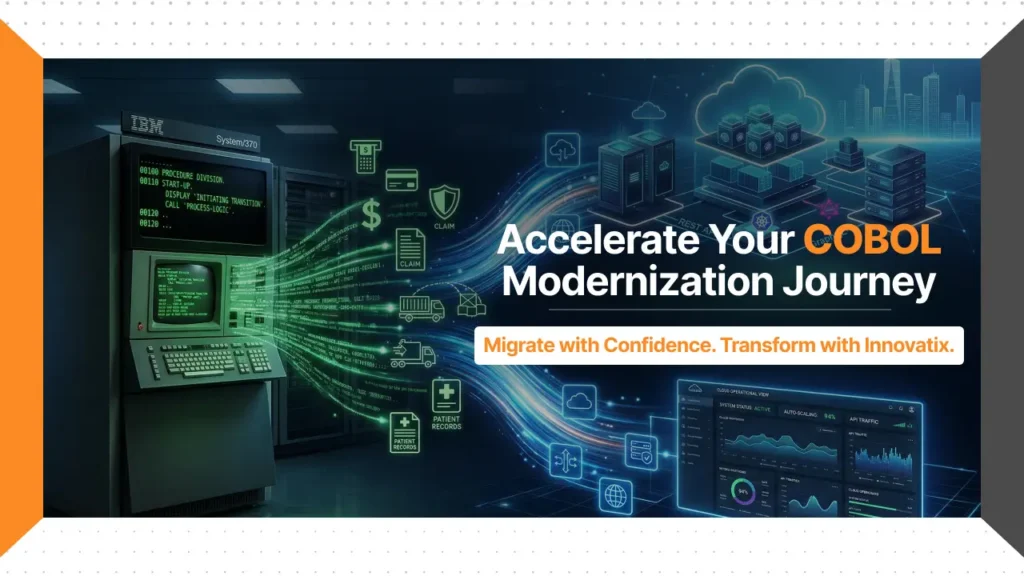
COBOL systems remain the silent backbone of the global economy — powering core banking platforms, insurance underwriting systems, government services, healthcare claims processing, and large-scale logistics networks. With over 220 billion lines of COBOL code in active production worldwide, these legacy systems process trillions of dollars in transactions daily. Yet the platforms housing this code — expensive IBM mainframes running z/OS, CICS, and IMS — are becoming increasingly difficult and costly to maintain.
Shrinking COBOL talent pools, skyrocketing mainframe operational costs, cybersecurity vulnerabilities, severe integration limitations with modern technologies, and mounting regulatory pressure are collectively forcing enterprise leaders to act decisively. For CIOs and CTOs, COBOL migration, COBOL modernization, and COBOL conversion are no longer optional IT projects — they are strategic imperatives essential for long-term business survival and competitive advantage.
Innovatix Technology Partners — a premier legacy application migration firm with over two decades of specialized experience and 450+ professionals — delivers end-to-end COBOL migration services that completely de-risk your mainframe modernization journey, preserve every line of critical business logic, and position your enterprise for scalable cloud-native growth. Visit us at www.migrateto.net.
The greatest risk in COBOL modernization is not code conversion — it is business logic loss. Over decades, COBOL systems have embedded incredibly complex rules across programs, copybooks, batch processes, transaction monitors, and data stores. This logic often reflects undocumented regulatory interpretations, proprietary financial calculations, and highly nuanced operational workflows that are absolutely business-critical. Any successful legacy system transformation and enterprise legacy modernization program must therefore be treated as a holistic business initiative — not simply a code rewrite. Innovatix’s disciplined approach ensures every business rule is discovered, documented, translated, and validated through rigorous COBOL business rules extraction before go-live, transforming what was historically a leap of faith into a controlled, measurable transformation that strengthens both operational stability and digital competitiveness.
Choosing the right target platform — Java, C# / .NET, or Python — is the most critical architectural decision. The unified comparison below evaluates COBOL against all four across 15 enterprise dimensions.
| Feature | COBOL (Legacy) | Java | C# / .NET | Python |
| Programming Paradigm | Procedural, top-down | Object-oriented, class-based | Object-oriented + functional | Multi-paradigm: OOP, functional, scripting |
| Runtime | IBM z/OS, CICS, IMS | JVM (cross-platform) | .NET CLR (.NET 8 cross-platform) | CPython (cross-platform) |
| Data & Arithmetic | PIC clauses, COMP-3, fixed-point | Primitives + BigDecimal | 128-bit decimal type | Dynamic typing, Decimal module |
| Database Access | VSAM, KSDS, IMS DB, DB2 | JDBC, JPA, Hibernate, NoSQL | Entity Framework, LINQ, SQL Server | SQLAlchemy, Django ORM, pandas |
| UI Capabilities | Green-screen 3270 terminals | Spring MVC, Thymeleaf, Android | Blazor, ASP.NET MVC, MAUI | Django, Flask, Streamlit |
| Cloud & Deployment | On-premises mainframe only | AWS, Azure, GCP, K8s, Docker | Azure, AWS, GCP (.NET 8) | Lambda, Azure Functions, Cloud Run |
| Scalability | Vertical only | Horizontal + vertical | Horizontal + vertical | Horizontal via ASGI + cloud |
| Concurrency | Batch-sequential | Multithreading, parallel streams | Async/await, TPL | asyncio, multiprocessing |
| APIs & Integration | Middleware only (MQ, CICS) | REST, GraphQL, gRPC, Kafka | Web API, gRPC, SignalR | FastAPI, Flask-REST, gRPC |
| DevOps & CI/CD | Waterfall, quarterly releases | Jenkins, GitHub Actions, Gradle | Azure DevOps, GitHub Actions | GitHub Actions, pytest |
| Security | RACF/ACF2 only | Spring Security, OAuth 2.0 | .NET Identity, Azure AD | Django security, cloud IAM |
| Testing | Limited, manual-heavy | JUnit, Mockito, Selenium | xUnit, NUnit, Playwright | pytest, unittest, Selenium |
| Talent | Critically scarce (avg. 55+) | Millions of developers globally | Large Microsoft community | #1 globally — largest community |
| Cost Model | MIPS licensing, high CapEx | Open-source + cloud OpEx | Open-source (.NET 8) + OpEx | Open-source + cloud OpEx |
| Best For | Legacy batch & transactions | Enterprise apps, microservices | Microsoft-stack, Azure workloads | Analytics, AI/ML, prototyping |
Key Takeaway: Java and C#/.NET are the primary language targets for full automated COBOL conversion and legacy code modernization. Python is best suited for data analytics, AI/ML components, and rapid prototyping of COBOL replacement logic. Innovatix helps you select and execute the optimal combination tailored to your enterprise.
Enterprise COBOL modernization programs typically follow one or more of these battle-tested strategies. Innovatix Technology Partners helps you select and execute the optimal approach based on your unique risk profile, budget, timeline, and compliance requirements. Whether you need immediate COBOL rehosting, full COBOL refactoring, strategic COBOL API enablement, or a phased legacy code modernization roadmap, our methodology ensures a controlled, measurable transformation.
1. Automated Translation / Refactoring — Converts COBOL code into modern languages such as Java, C#, or Python via automated COBOL conversion tools like CodeAuto. Permanently eliminates COBOL dependency and solves the talent shortage. Requires rigorous golden-run testing and parallel validation to ensure functional equivalence.
2. API Enablement (Wrap and Extend) — Wraps legacy COBOL functionality with modern RESTful or GraphQL APIs to enable digital channels, mobile integration, and real-time web services without full COBOL replacement. A powerful strategic interim step toward complete modernization.
3. Incremental Modernization (Strangler Fig Pattern) — Gradually replaces individual legacy components with COBOL to microservices architecture over time. Delivers the best risk-adjusted outcome for regulated enterprises with moderate budgets. Enables phased migration with continuous value delivery while maintaining compliance and availability.
4. Rehosting (Lift and Shift) — Moves COBOL applications from expensive mainframe environments to lower-cost distributed platforms or cloud infrastructure without code changes. Preserves 100% of core logic. Typical result: 40–70% mainframe cost reduction.
When trillions in daily transactions and decades of embedded business rules are at stake, you need a mainframe migration services partner with proven expertise, proprietary tools, and a flawless track record. Innovatix Technology Partners has consistently delivered successful legacy application migration programs across the most complex enterprise environments — from Fortune 500 banks to federal government agencies — with zero operational downtime and complete regulatory compliance.
Tools increase productivity by 30–80%, dramatically cutting timelines and costs.
From initial COBOL business rules extraction through final mainframe application migration cutover, Innovatix provides a single accountable partner for the entire modernization lifecycle — ensuring your enterprise emerges stronger, faster, and fully prepared for the digital future.
Don’t let your mission-critical applications become an operational liability constrained by a discontinued technology paradigm, a rapidly shrinking talent pool, and exponentially rising mainframe cost reduction pressure. Whether you need mainframe replatforming, full automated COBOL conversion, or a phased mainframe to cloud strategy, contact Innovatix Technology Partners today for a free, comprehensive evaluation of your COBOL environment and begin transforming risk into long-term resilience and growth.
The time really has come to virtualize your VFP application. We are not talking about migration or conversion or bringing ...
In business technology, it’s all too easy to leave systems that work untouched. When a legacy application is working well ...
Visual Basic 6.0 was the foundation of enterprise computing for decades. It was launched in 1998 and was able to ...