
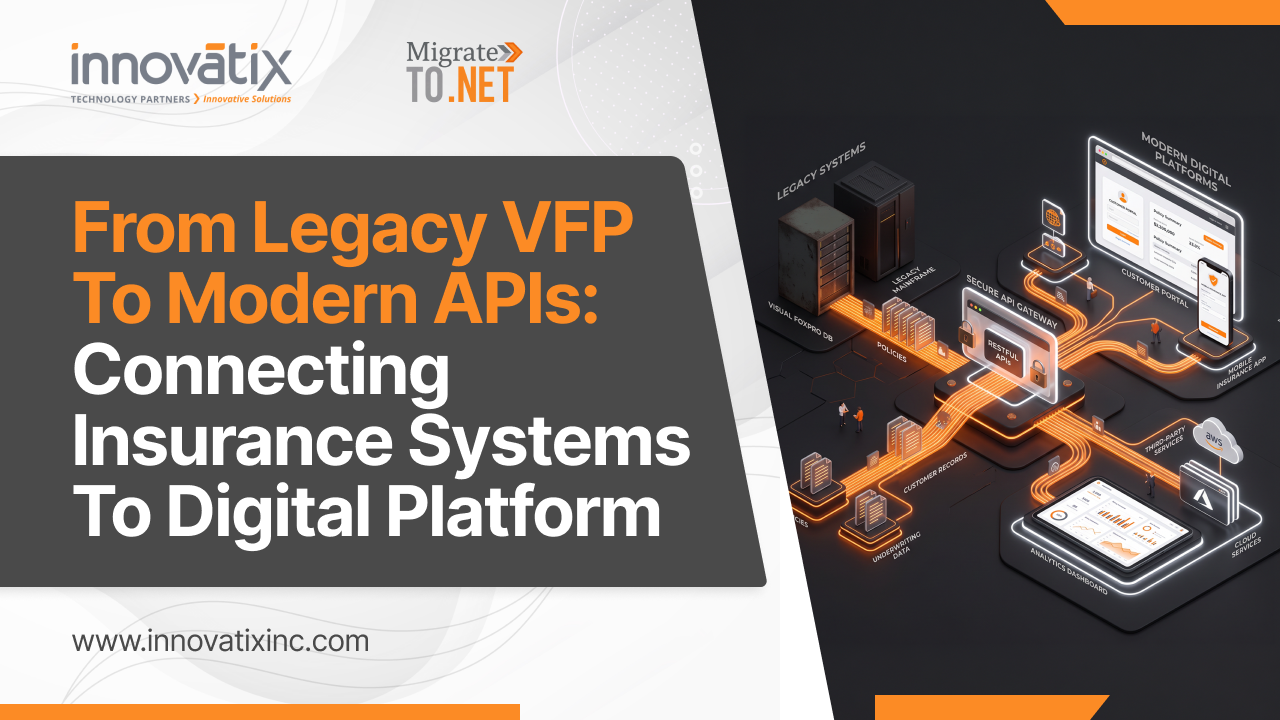
From Legacy VFP to Modern APIs: Connecting Insurance Systems to Digital Platforms

From Legacy VFP to Modern APIs: Connecting Insurance Systems to Digital Platforms

By Nellaiappan L | Published on August 21st, 2026 |

For decades, Visual FoxPro (VFP) was the fall-back language for insurance back office. VFP was known for its ability to tightly integrate its desktop database engine, and combined with its swift data access (at least locally) and screen-building features, the software was used for everything from policy administration to claims processing, underwriting raters to broker accounting systems.

But, back more than 10 years ago (Jan 2015) Microsoft officially discontinued Extended Support for Visual FoxPro 9.0. Despite all this, there are still hundreds of insurance carriers, Managing General Agents (MGAs) and Third-Party Administrators (TPAs) that depend on these legacy VFP systems to drive mission-critical, revenue-generating lines of business.

Although VFP systems are still fairly fast and stable for internal users within a local network environment, in an age of embedded insurance, real-time API integration, instant mobile claims and automated quote-to-bind systems, they have turned into operational roadblocks. A 32-bit file-based desktop database engine is simply not designed for lightweight JSON payloads, RESTful web services, event driven architectures and cloud-native elasticity that modern digital platforms require.

Among the most pressing issues for insurance IT leaders today is how to effectively bridge the architectural divide between legacy VFP environments and today’s API-driven ecosystems without disrupting their business and losing data.

Whitepaper—Visual FoxPro Migration in 2026: Using RAG to Ingest and Document Decades of Legacy Logic

This whitepaper details an AI-accelerated approach to migrating legacy Visual FoxPro systems in 2026 by using Retrieval-Augmented Generation (RAG) to extract, document, and bridge decades of hidden business logic to modern microservices.

The Structural Challenges of VFP in a Digital-First World

In order to be able to modernize the existing legacy Visual FoxPro (VFP) systems, the technical architects need to start by tackling the fundamental technical constraints that exist with the VFP platform:

1. File-Based Database Architecture (.DBC / .DBF)

Unlike client-server databases such as PostgreSQL or Microsoft SQL Server that run managed service daemons, VFP relies on direct file-handle locking over SMB/LAN connections. Exposing raw .DBF files directly to web servers or internet-facing services creates a severe risk of table index corruption (.CDX failures) and catastrophic performance degradation over WAN or cloud connections.

2. 32-Bit Monolithic Execution Runtime

VFP is a 32-bit application, and therefore has 2GB per process memory limit. This footprint easily can be overwhelmed by modern API gateways, concurrent webhooks and asynchronous web worker models, resulting in memory leaks, process starvation and server crashes during peak web traffic.

3. Tightly Coupled Business Logic

In classic VFP applications, business logic, validation rules, data access routines, and UI form event handlers (such as Valid, InteractiveChange, and Click events) are deeply tangled within .SCX visual forms and .VCX class libraries. Extracting business logic for external API consumption requires surgical refactoring rather than a simple database connector.

Modernization Pathways: From Quick Integration to Full Cloud-Native Architecture

There is no need for insurers to take a high-risk, multi-million-dollar “big bang” approach to integrate VFP legacy systems with modern digital ecosystems. Phased modernization methodology allows you to get instant API connectivity, and creates a low-risk migration bridge.

Strategy 1: Building the Bridge — Modern API Wrappers & Middleware

To enable web portals, mobile apps, and comparative rating engines to interact with VFP data immediately without exposing DBF files directly to web traffic, enterprises deploy intermediate API wrappers and staging synchronization databases:

  • The Read Path (Real-Time Data Mirroring): Asynchronous change data capture (CDC) scripts or lightweight polling services replicate VFP .DBF tables into an intermediate SQL Server or PostgreSQL database in near real time. Modern REST APIs (built on .NET Core or Node.js) query this staging database directly, delivering sub-millisecond response times to external digital channels without creating lock contention for active desktop users.
  • The Write Path (COM Server / Micro-Services Integration): When performing a transaction (e.g., binding a policy, submitting a new claim), the API gateway calls compiled VFP .EXE or .DLL COM objects running in an isolated worker pool. This configuration is used to route XML/JSON input to run internal VFP validation rules in a safe manner before writing back to master files.

Strategy 2: Incremental Service Decoupling (The Strangler Fig Pattern)

Once initial API wrappers are established, carriers systematically replace legacy VFP modules using the Strangler Fig Pattern. Rather than replacing the whole system at once, high-value, high-frequency workflows are incrementally extracted and rewritten into independent microservices:

  1. Rating & Quoting Engine Extraction: Rating algorithms are coded as procedures within VFP (.PRG) are then refactored into cloud-native microservices (REST/gRPC APIs hosted on AWS/Azure), with instant integration for comparative rating with insurtech brokers.
  2. Policy Administration & Document Generation: Policy issuance and claims management workflows are migrated into scalable .NET / C# backend services backed by cloud databases, leaving the legacy VFP desktop app as a read-only historical archive over time.

Ensuring Data Integrity, Security, and Regulatory Compliance

Modernizing insurance infrastructure is dependent on adherence to regulatory requirements (such as SOC 2, HIPAA, state insurance commissioner requirements). When moving a VFP system to an API based system, enterprise level security controls need to be put in place:

  • Zero Trust Security & Authentication: Legacy VFP applications have traditionally trusted Windows network share permissions. Modern API endpoints on top of VFP data should require OAuth 2.0 / OIDC authentication through JWT token validation and fine-grained Role Based Access Control (RBAC).
  • Transactional Integrity & Audit Logging: FP does not have native audit logging of individual row changes and they are not immutable. All API-driven transactions should be audited with the aid of the middleware layers, with the following information being logged: request payloads, caller identities, and transaction statuses with timestamp information.

Accelerate Your Modernization Journey

As insurers strive to stay competitive, seamlessly integrate with insurtech ecosystems, and provide a seamless customer experience, moving from monolithic Visual FoxPro platforms to resilient, API-first approaches is crucial. However, decades of legacy VFP code-base need specific skillsets on both legacy system engineering and on the modern cloud platform development.

From automated VFP code extraction and microservices refactoring to cloud database migration and secure API gateway integration, Innovatix Technology Partners has the technical expertise and established processes to modernize core systems. Innovatix Technology Partners helps carriers transform legacy assets into agile, high-performance, API-ready enterprise platforms with minimal operational risk.


Whitepaper—Visual FoxPro Migration in 2026: Using RAG to Ingest and Document Decades of Legacy Logic

This whitepaper details an AI-accelerated approach to migrating legacy Visual FoxPro systems in 2026 by using Retrieval-Augmented Generation (RAG) to extract, document, and bridge decades of hidden business logic to modern microservices.

Nellaiappan L on Linkedin
Nellaiappan L
Application Delivery Manager at Innovatix Technology Partners
Nellaiappan is the Application Delivery Manager for Innovatix’s .NET migration team. Subsequently, Nellai leads the Migration Service to migrate client legacy systems to the latest technologies such as .NET. As a PMP certified professional, he has received accolades from clients for his efficient leadership. Incidentally, during his first migration project, Nellai accelerated the migration resulting in a new service offering from Innovatix Technology Partners. Later, Nellai worked on an array of proprietary migration tools that form the backbone of the Migrations Practice at Innovatix Technology Partners.

Nellaiappan holds a Masters in Computer Applications and has 17+ years experience in developing and leading Windows and Web based Applications using Microsoft Technologies.
Recent Blogs

How to Virtualize your VFP Application
Read Blog
VB6 to .NET Migration in 10 Steps
Read Blog
Why a FoxPro Conversion could cause you problems If
Read Blog
FoxPro to .NET Conversion could give you Migration Blues
Read Blog
6 Unforgettable Steps in The ASP to ASP.NET Migration
Read Blog