
By Nellaiappan L | Published on August 7th, 2026 |
Legacy software systems power mission-critical operations across industries ranging from finance and healthcare to logistics and government. These monolithic applications can be written in COBOL, Visual FoxPro (VFP), Visual Basic 6 (VB6), Classic ASP, C++ or legacy Java and include decades of embedded business logic. But when the original developers begin to step down and the documentation is limited or nonexistent, a modern engineering team is left with a huge problem: figuring out how the code base works.
Manual deciphering of millions of lines of unstructured legacy code is time consuming, prone to human error and expensive. Here is how Artificial Intelligence (AI) revolutionizes the traditional software engineering. Using dedicated AI models built using legacy syntax and architectural styles, developers will be able to analyze, document, and understand monolithic applications in a fraction of the time.
Leading the way in this AI-powered transformation is CodeAuto, a proprietary AI accelerator built by Innovatix Technology Partners, the world’s leader in legacy application modernization. Let’s examine how AI, specifically CodeAuto, can assist developers in navigating large and intricate legacy codebases, addressing technical debt, and setting the stage for a cloud-native transformation.
To appreciate the value that AI brings to legacy code opacity, first one must understand the reasons behind the opacity of legacy applications:
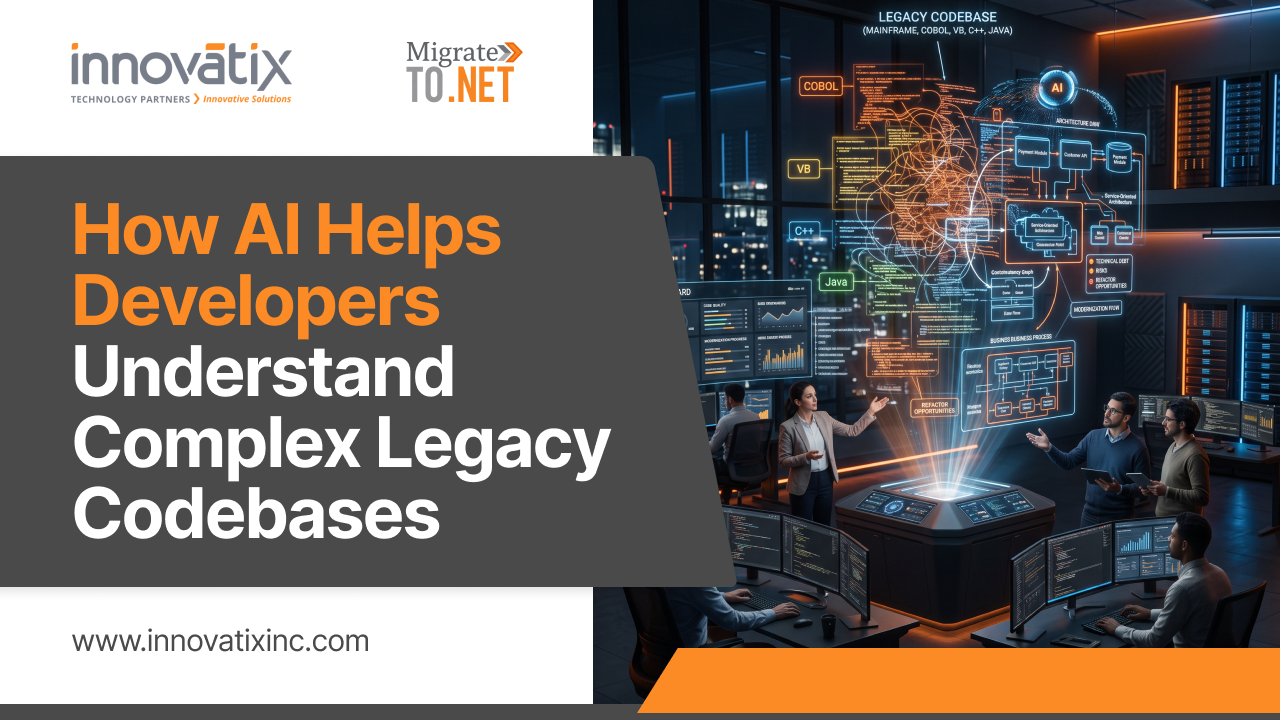
AI functions as a multi-layered cognitive processor that understands, parses and contextualizes codebases that cannot be manually line-to-line reviewed.
The greatest value in a legacy system is not its architecture, but its embedded logic—the custom rules, calculation formulas, validation checks, and data transformations accumulated over years of operations. AI models parse legacy syntax across disparate files, identifying hidden dependencies and mapping how data flows through the application. Instead of spending months reverse-engineering a module, developers gain an immediate, high-level map of the core logic.
AI tools translate complex, low-level legacy functions into structured, human-readable specifications. Rather than deciphering dense procedures or procedural scripts, developers can read auto-generated summaries explaining:
This capability bridges the language gap between legacy platforms and modern software engineers, enabling teams to onboard quickly.
In the case of legacy monoliths, adding one line of code to one file can lead to some unforeseen failure in some completely unrelated part of the system. AI Engines conduct structural static analysis, call graph mapping, data relationships and shared resource mapping across the full application footprint. Developers can now visualize how the components interact, pinpoint possible bottlenecks, dead code and potential refactor targets that are prone to risks.
Legacy applications often contain sensitive customer, financial, or healthcare information, but lack modern privacy controls. AI-driven analyzers analyze data definitions and queries in the codebase and identify problem areas such as GDPR or HIPAA compliance gaps by pinpointing where sensitive data is stored, transformed, or transmitted.
General-purpose AI coding assistants can provide general syntax explanations, but enterprise legacy monoliths need specialized, domain-specific AI. Innovatix Technology Partners’ CodeAuto is created for enterprise legacy modernization.
Innovatix’s proprietary suite of tools also includes specialized analyzers such as CodeMatrix and DataMorph, which complement the AI-powered capabilities of CodeAuto. It goes beyond simple code explanation to deliver actionable intelligence for enterprise developers and migration architects:
CodeAuto is trained on millions of lines of enterprise legacy code. Whether your organization relies on COBOL mainframes, Visual FoxPro databases, VB6 forms, C++ desktop tools, or legacy Java frameworks (Struts, EJB, JSF), CodeAuto understands the idiomatic patterns and nuances specific to each platform.
In tandem with Innovatix’s SpecGenerator tool, CodeAuto reads forms, classes, stored procedures, and scripts, automatically outputting functional and technical specification documents. This eliminates the manual documentation phase that typically consumes 30% to 40% of migration discovery timelines.
CodeAuto does not just explain what the code does—it highlights performance bottlenecks, redundant routines, and memory leaks. It provides developers with actionable recommendations for refactoring monolithic code into modular, cloud-ready microservices or clean architectures targeting .NET 8, Spring Boot, Python, or Angular.
Understanding your legacy code base is the first step; transforming that knowledge into a robust, modern, cloud native application means you need a trusted engineering partner. Innovatix Technology Partners combines an unmatched technology, scale and experience:
Legacy codebases don’t need to be a black box that consumes your IT budget and impedes innovation. This synergy of the artificial intelligence of CodeAuto and the deep domain expertise of Innovatix Technology Partners enables enterprises to unlock their legacy systems, maintain decades of core business value, and move smoothly to modern, cloud-native architectures.
To explore how CodeAuto can help your engineering team analyze and modernize your legacy applications, visit CodeAuto or discover end-to-end modernization services at Innovatix Technology Partners.