
VB6 to .NET: What Businesses Need to Know Before Migrating

VB6 to .NET: What Businesses Need to Know Before Migrating

By Joe Rafanelli | Published on August 14th, 2026 |

Although Microsoft has officially retired support for Visual Basic 6.0 (VB6) more than ten years ago, thousands of businesses around the globe are still using legacy VB6 applications as a crucial part of their business processes. These applications have proven to be reliably quiet for more than 20 years, ranging from custom inventory management systems to financial engines to unique systems built to support specific operations.

But operating mission-critical processes on a 1998 system is becoming a growing operational, technical and compliance challenge. Operating systems continue to change, cloud adoption continues to grow, and cybersecurity threats continue to rise – making legacy software increasingly unsustainable.

Converting VB6 to Microsoft .NET is a clear path towards system modernization, increased security, and long-term scalability. But, the move to a new codebase is not simply a straight code conversion, but a strategic evolution. Here’s what business leaders and IT decision-makers need to know as they make decisions for a successful legacy transformation.

Case study—Modernizing A Legacy FoxPro Investment Application To A Browser-Based .NET Platform

This case study outlines how Innovatix Technology Partners successfully modernized a mission-critical legacy Visual FoxPro investment application into a browser-based Angular, C#.NET, and SQL Server platform in 11 months while preserving all business logic and achieving 100% report data accuracy.

Why Businesses Are Moving Away From VB6

While the “if it isn’t broken, don’t fix it” mindset often keeps legacy applications in place, the hidden costs of maintaining legacy software escalate every year.

  • Severe Security & Compliance Vulnerabilities: VB6 does not support the modern standards in encryption, secure authentication protocols, and cybersecurity frameworks. Running legacy executables on modern Windows platforms is problematic for compliance regulations, such as GDPR, HIPAA and PCI-DSS.
  • The Shrinking Developer Talent Pool: Finding engineers skilled in both vintage 16/32-bit VB6 constructs and modern enterprise architecture is increasingly difficult. Senior developers are retiring and that’s causing a huge operational vulnerability because of the lack of talent.
  • Lack of Cloud & Mobile Readiness: VB6 was designed for standalone desktop applications. It does not have built-in support for RESTful Web APIs, modern web interfaces, cloud based deployment and microservices architectures.

What to Consider Before a VB6 Migration

There are a number of technical and organizational aspects that need to be considered before a single line of code is written in a successful VB6 legacy application modernization project. Critical VB6 migration considerations include:

  • Target Architecture Selection: Determine whether the application should remain a desktop utility (using WPF or Windows Forms) or evolve into a cloud-hosted web application (using ASP.NET Core or Angular/React frontends).
  • Business Logic Retention: Determine what functionality is criticalto daily operations and which legacy modules can be retired or streamlined.
  • Coexistence & Minimizing Downtime: Determine if it is best to perform a “big bang” cutover or an incremental, module-by-module migration with hybrid interop layers, based on operational risk.

Common Challenges When Moving VB6 Applications

Understanding potential roadblocks early prevents project delays and budget overruns. Typical VB6 migration challenges and risks include:
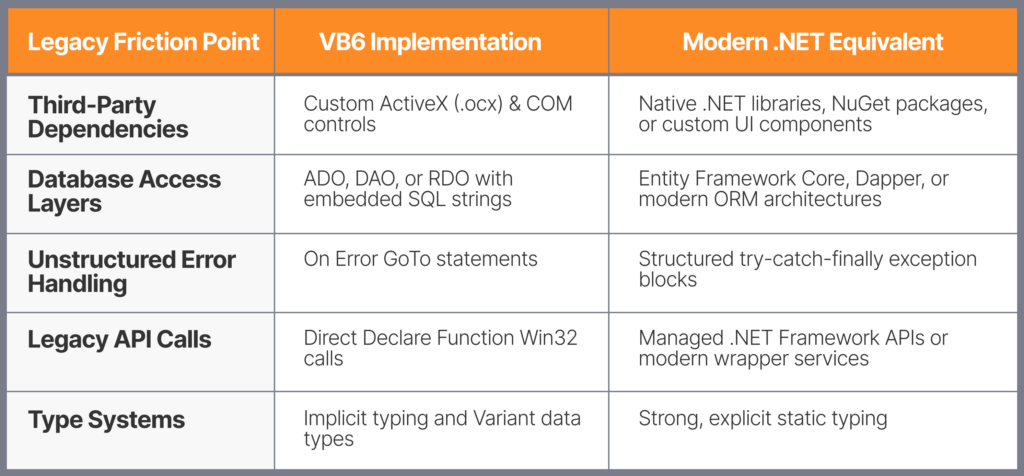
Common Challenges When Moving VB6 Applications

Overcoming these VB6 migration risks requires a balanced strategy: combining automated code translation for standard routines with manual refactoring for complex business logic.

How to Assess a Legacy VB6 Application

Before launching a migration project, conducting a comprehensive VB6 application assessment is essential. A structured audit covers three major areas:

  1. Codebase Health Audit: Measure line count, complexity, dead code, duplicate routines, and hardcoded variables.
  2. Data & Schema Mapping: Document database tables, stored procedures, raw SQL queries embedded in UI controls, and data access libraries.
  3. Integration Points: Catalog external interfaces, background jobs, hardware drivers, and third-party software integrations.

VB6 Application Compatibility and Dependencies

Auditing of external components is one of the biggest challenges for VB6 migration planning. Vintage applications often support 3rd party ActiveX controls (.ocx), custom DLLs, and COM objects that no longer are supported or are not compatible with 64-bit versions of the operating system.

Early identification of these dependencies means that engineering teams can also identify modern .NET equivalents or plan for custom UI development well before execution begins.

How to Estimate VB6 Modernization Effort

Accurate estimation requires looking beyond raw lines of code. To build a realistic timeline and budget, evaluate:

  • Functional Complexity: The ratio of standard UI forms versus intricate mathematical, data processing, or algorithmic rules.
  • Component Replacement: The effort required to replace obsolete third-party controls with modern open-source or commercial .NET libraries.
  • Automated vs. Manual Scope: Estimating what percentage of the codebase can be transformed using automated parsing tools versus modules requiring architectural redesign.

Choosing the Right Migration Partner

Since migrating off VB6 spans two software eras, internal IT teams often don’t have the toolsets and dual-platform knowledge to travel between legacy constructs and modern .NET frameworks smoothly.

Innovatix Technology Partners is a leading legacy migration services partner, known for its ability to provide a smooth transition. Bringing together decades of domain knowledge from legacy technologies such as VB6, Visual FoxPro and Classic ASP with modern .NET cloud architectures, Innovatix provides end-to-end modernization solutions.

Their proven methodology involves using cutting-edge automation tools in combination with strategic engineering to refactor complex legacy code bases to be secure, scalable and future-ready .NET applications and protecting important business logic.

Final Thoughts

Modernizing off VB6 is not merely a technical upgrade. It’s an investment in your enterprise’s agility, security, and long-term competitiveness. With insight into architectural needs, dependency risks can be eliminated and legacy migration experts can be brought on board to ensure that legacy technical debt is successfully converted into scalable and high-performance digital assets.

Case study—Modernizing A Legacy FoxPro Investment Application To A Browser-Based .NET Platform

This case study outlines how Innovatix Technology Partners successfully modernized a mission-critical legacy Visual FoxPro investment application into a browser-based Angular, C#.NET, and SQL Server platform in 11 months while preserving all business logic and achieving 100% report data accuracy.

Frequently Asked Questions (FAQs)

1. What should businesses consider before migrating a VB6 application?

Before embarking on a VB6 migration, businesses should evaluate application dependencies, third party components, code complexity, database compatibility, security exposure and business-critical functionality.

2. What are the common challenges of migrating legacy VB6 applications?

Examples of common issues are legacy code, outdated dependencies, unsupported components, database compatibility, lacking documentation, and ensuring application functionality during modernization.

3. How can businesses reduce the risks of a VB6 application migration?

Companies can minimize migration risks by conducting a thorough application assessment, understanding the applications’ dependencies, prioritizing critical functions, migrating incrementally and developing a well-defined migration plan prior to modernization.


Joe Rafanelli on Linkedin
Joe Rafanelli
Director of Migration Services at Innovatix Technology Partners
Joe Rafanelli is the Director of Migration Services at Innovatix Technology Partners, a Macrosoft, Inc. company. In this capacity, Joe acts as the single point of contact for Innovatix’s migration solutions. Additionally, he collaborates with internal technology analysts to understand requirements, work scope, and maintain client relationships ensuring their satisfaction .

Prior to joining Innovatix in May 2017, Joe had a resplendent career in the Banking Industry spanning 25 years. He focused on Account Management, Project Management, Implementation Management, and Product Development for companies like JPMorgan, Citigroup and Brown Brother Harriman.

Joe is excellent at improving the client experience by driving change management projects to completion. Joe has B.S. Finance, MBA Investment Finance, Project Management certificate & Database Management certificate.
Recent Blogs

How to Virtualize your VFP Application
Read Blog
VB6 to .NET Migration in 10 Steps
Read Blog
Why a FoxPro Conversion could cause you problems If
Read Blog
FoxPro to .NET Conversion could give you Migration Blues
Read Blog
6 Unforgettable Steps in The ASP to ASP.NET Migration
Read Blog